
Here's the problem: many business owners think their logo is their brand. So the logo gets polished while everything else — the website, the invoices, the delivery van, the storefront sign — drifts out of sync. The result is a business that looks like three different companies depending on where a customer encounters it.
This guide breaks down what branding and design actually mean, the core elements that hold a brand together, the process professionals follow to build one, and how to carry that identity beyond the screen and onto real-world assets like fleets and signage.
Key Takeaways
- Branding, brand identity, and brand design are distinct: strategy, system, and execution
- Five core elements (logo, colour, typography, imagery, and voice) must work together as one system
- A structured process from goal-setting to style guides prevents costly inconsistency
- Physical touchpoints like vehicle wraps and signage are high-impact assets most brands overlook
What Is Branding and Design?
Branding is the strategic, internal work: defining your mission, values, market position, and the personality your business wants to project. It's the "why" behind every decision.
Brand design is the visual execution of that strategy: the tangible output customers actually see and touch, from your logo to your storefront signage.
Neither works without the other: a strategy that never gets designed stays invisible to customers, while a design built on no strategy looks polished but says nothing real about the business.
Branding vs. Brand Identity vs. Brand Design
This is where most confusion happens, and it's usually the direct answer people are searching for when they ask "what is branding and design":
- Branding = the strategy (positioning, mission, target audience, voice)
- Brand identity = the system (your logo, colour palette, fonts, tone — the rulebook)
- Brand design = the application (how that system shows up on your website, packaging, vehicles, and signage)
Businesses that treat these as interchangeable tend to make one costly mistake: they invest heavily in a logo and assume the job is done.
A logo alone isn't a brand identity, and a brand identity that never gets applied consistently across every touchpoint isn't doing its job. When recognition breaks down, the logo usually isn't to blame; inconsistent use across every touchpoint is.

The Essential Elements of Brand Design
A cohesive brand relies on several interlocking pieces working together, not a single asset carrying the whole load.
Logo Design
A strong logo is simple, scalable, and limited to a handful of colours so it reads clearly whether it's on a business card or a 20-foot storefront sign.
A landmark study analysing 195 real logos across 13 design characteristics found that logos rated highest for recognition tended to be natural, harmonious, and moderately elaborate rather than overly complex (Henderson & Cote, Journal of Marketing, 1998). Complexity doesn't earn recall. Clarity does.
Color Palette
Colour choice signals personality before a single word of copy is read.
Research on colour and marketing found that hue and saturation affect brand perception, with red cueing excitement and blue cueing competence (Labrecque & Milne, 2012). A signature palette used consistently, rather than one that shifts by season or by which employee designed the last flyer, builds recognition over time.
Typography
Limit your brand to 2-3 complementary fonts, used the same way every time:
- Serif fonts read as established and trustworthy
- Script fonts feel personal or luxurious
- Sans-serif fonts read modern and direct
Mixing five different fonts across your materials signals disorganisation, not creativity.
Imagery, Iconography & Mascots
Consistent illustration style, icon treatment, or even a mascot can carry a brand's personality further than words alone.
Duolingo's green owl, Duo, has been part of the brand since its 2012 launch and now anchors the entire visual system, including the custom typeface and app illustrations built around his silhouette. Not every business needs a mascot, but every business needs a recognisable visual thread running through its imagery.
Brand Voice & Messaging
Tone of voice, whether formal, playful, direct, or warm, has to match the visuals. A brand with a bold, energetic logo but stiff, corporate copy feels disjointed. Voice and visuals should read like they came from the same company.
The Branding Design Process: A Step-by-Step Guide
Effective brand design doesn't start with visuals. It follows a sequence.
- Define business goals and brand personality. Designers typically gather 4-5 keywords or a brief from stakeholders to establish the "why" before any concept work begins.
- Conduct market and audience research. This runs on two tracks: competitor analysis to find white space, and audience research to align with what customers actually respond to.
- Design the logo and visual identity. Concepts get explored, colours and styles get narrowed down, and the final logo is stress-tested at different sizes and on different surfaces: a business card, a website favicon, a truck door.
- Extend style across brand materials. The approved identity then gets translated onto business cards, correspondence, packaging, and larger-format applications like vehicle wraps and signage.
- Document a brand style guide. This locks in correct and incorrect usage of logos, colours, and fonts so every future asset (digital or physical) stays on-brand, regardless of who produces it.
Skip any of these steps, and the gaps show up later as inconsistency you have to fix retroactively, which almost always costs more than doing it right the first time.

From Screen to Street: Applying Brand Design Across Every Touchpoint
Most branding advice stops at digital and print. Your website, social media graphics, business cards, and packaging should all mirror your style guide exactly: same colours, same fonts, same tone. That part is well understood.
What gets overlooked are the touchpoints people encounter in the real world, often more frequently than they visit your website.
Physical & Environmental Branding: Where Design Meets the Real World
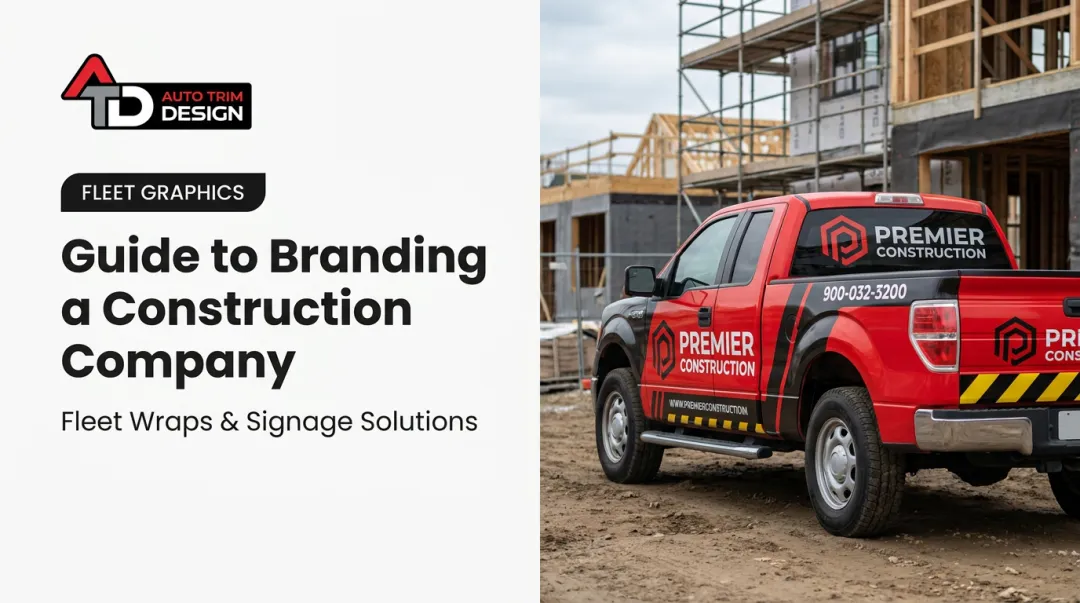
Vehicle and fleet wraps function as mobile advertising: your brand travels through neighbourhoods, sits in traffic, and parks outside job sites without any recurring media spend. But a wrap is only as good as its colour accuracy. If the blue on your truck doesn't match the blue on your website, the brand feels fractured the moment someone cross-references the two.
This is where fabrication quality matters as much as design talent. We're a 3M Platinum Select Fabricator, one of only six companies in Canada holding that designation. Our high-end colour-profiling process on printing equipment ensures a client's brand colours reproduce identically across every vehicle, sign, and surface we touch.
Signage extends the same logic into physical space:
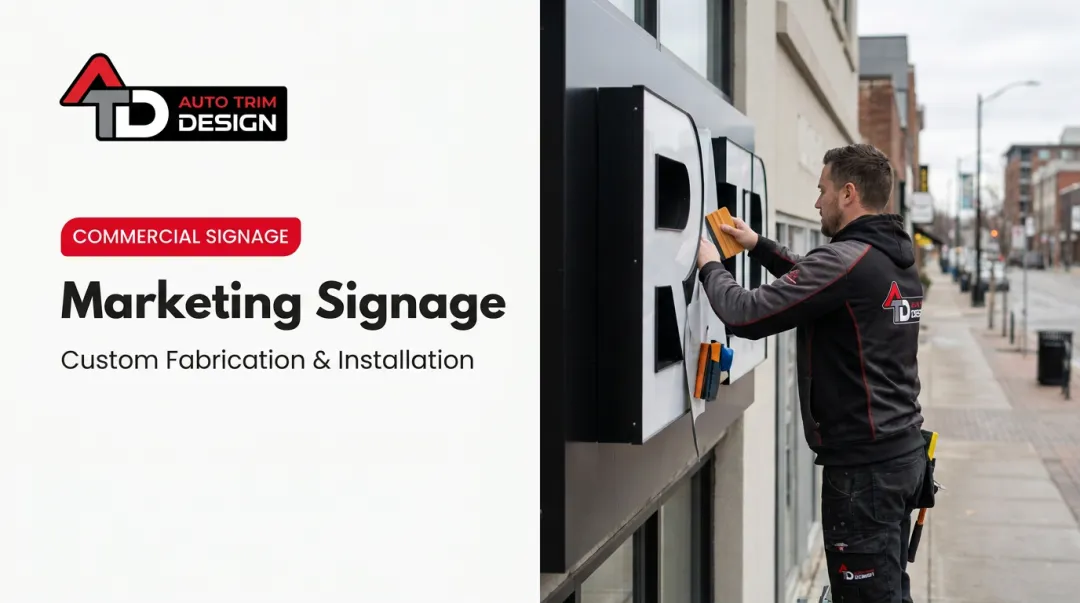
- Building signage and storefront branding
- Wall murals and interior wall wraps
- Window graphics and frosted film
- Floor graphics for retail and warehouse environments
We've applied this at national scale: our rebrand of Avenir Energy's fleet involved wrapping vehicles that operate everywhere from Vancouver Island to Newfoundland, with the 10th vehicle needing to look identical to the first regardless of which coast it's parked on.

Good design still fails without proper installation. Bubbling, misaligned graphics, and lifting edges turn a well-designed wrap into something that looks amateurish within months. Professional installation and quality control determine whether a brand looks polished in the real world or not.
When you're evaluating a branding or fabrication partner, look past portfolio aesthetics and ask about proven large-scale execution and industry certifications. Design talent gets you a great concept. Fabrication and installation expertise are what make that concept hold up on the street.
How Much Does Branding and Design Cost?
Cost depends entirely on scope. A standalone logo costs far less than a complete identity system with style guidelines, packaging design, and environmental applications built in.
Is $500 too much for a logo? Not necessarily. Marketplace data shows freelance logo projects typically fall between $150 and $1,500 CAD, depending on complexity and experience level. $500 is a reasonable price point for a freelancer-designed logo aimed at an early-stage or small business.
Agencies work differently. Most agency-led branding projects run $10,000 to $49,999 CAD, covering strategy, positioning, naming, full visual identity, and guidelines — not just a logo file. Judge cost against scope and experience, not the number alone.
| Provider Type | Typical Range (CAD) | What's Included |
|---|---|---|
| Freelancer (logo only) | $150-$1,500 | Logo concept, basic files |
| Agency (full identity) | $10,000-$49,999+ | Strategy, logo, guidelines, applications |
Here's why the upfront spend pays back. A 2018 Motista study of over 100,000 U.S. consumers found that customers who felt emotionally connected to a brand delivered 306% higher lifetime value than merely satisfied customers (Motista, 2018). Consistent, well-executed branding is one of the primary ways that emotional connection gets built. The same logic applies to physical brand touchpoints — vehicle wraps, signage, and wall murals — where cost tracks to scope, materials, and installation quality rather than square footage alone.
Frequently Asked Questions
What is branding and design?
Branding is the strategy behind how a business wants to be perceived — mission, values, and positioning. Brand design is the visual execution of that strategy across every touchpoint customers see.
Is $500 too much for logo design?
No. $500 is a reasonable price for a freelancer-designed logo for a small or early-stage business. Full brand identity systems from agencies typically cost thousands of dollars more, depending on scope.
What are the 7 pillars of branding?
There's no single universal standard, but HubSpot's widely referenced branding framework includes purpose, consistent presence, emotional connection, agility, employee advocacy, customer loyalty, and cultural awareness.
What is the 3-7-27 rule of branding?
It's an informal rule of thumb suggesting people notice a brand after roughly 3 exposures, start remembering it after 7, and build real trust after 27. It's not a validated law, and the exact numbers vary by source.
How long does it take to build a complete brand identity?
A simple logo can take days to a couple of weeks. A full identity system with research, guidelines, and physical rollout across signage or fleets can take several months.
How can vehicle wraps and signage strengthen my brand design?
Professionally fabricated wraps and signage extend your visual identity into high-visibility physical spaces, reinforcing recognition through daily impressions that digital channels alone can't match.